

Research Areas
Wei’s group has long been dedicated to theoretical investigations on strength and fracture of solids. We have made systematic and innovative progress in solving stress fields for typical defects and cracks in solids, mechanisms of solid strength and plastic deformation, constitutive models, and battery service reliability. We are now striving to integrate AI with conventional mechanical methods to advance the developments in both theoretical and experimental approaches to solid strength and failure, as well as the in-service reliability assessment of engineering structures.
Our group is continuously recruiting undergraduate students, graduate students, and postdoctoral researchers with academic backgrounds and research experience in mechanics, mechanical engineering, material science, and other related fields. We warmly welcome interested individuals to join us!
1. Micro-mechanisms of Strength and Plastic Deformation in Metallic Materials
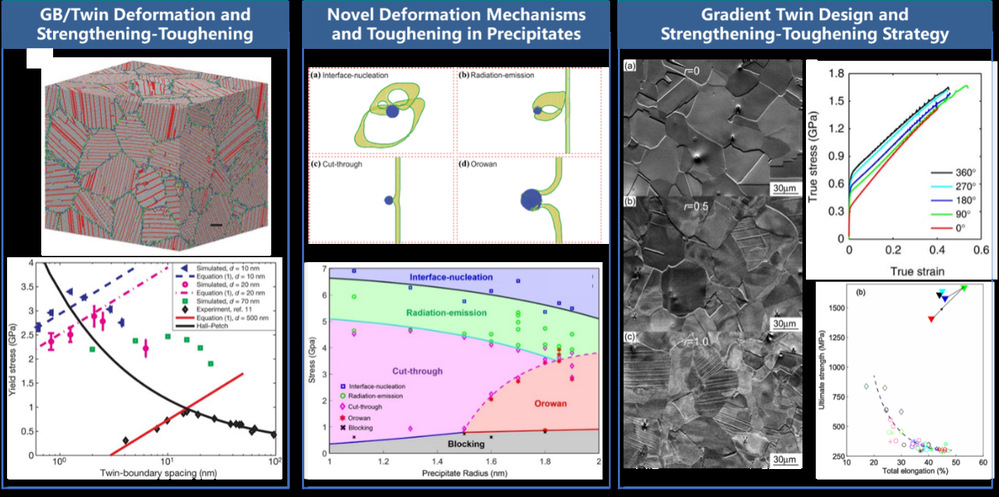
In national strategic sectors such as aerospace, energy transportation, and national defense equipment, there is a widespread and urgent demand for new structural materials that possess multiple mutually exclusive mechanical properties, such as high strength-high ductility and high strength-high toughness. However, metallic materials have long been constrained by the fundamental strength-toughness trade-off—where a significant increase in strength is often accompanied by a drastic loss of ductility and toughness. This intrinsic constraint between mechanical properties not only hinders the development and application of next-generation high-performance structural materials but also serves as the primary bottleneck and core scientific problem restricting the safety and reliability of advanced engineering structures.
The macroscopic mechanical performance of metallic materials is fundamentally governed by the evolution and interaction of multi-scale microscopic defects, such as dislocations, interfaces, and precipitates. Revealing the internal correlation between microscopic interface behavior and macroscopic strength-toughness response is a central task in the study of solid constitutive relations. Addressing these long-standing key challenges in the fields of mechanics and materials, our group focuses on the multi-scale mechanical analysis of crystal microstructures. We are dedicated to establishing the micro-macro correlation of mechanical properties and have achieved a series of breakthroughs in the laws of dislocation dynamics, as well as the microscopic deformation mechanisms, macroscopic strength-toughness control, and multi-scale design of twin boundaries, grain boundaries, and precipitate interfaces. Future research will continue to explore the dynamic evolution mechanisms of complex microstructures under extreme service conditions, providing mechanism-driven theoretical support for the development of next-generation high-performance structural materials.
2. Constitutive of Solid Materials and Artificial Intelligence-assisted Modeling
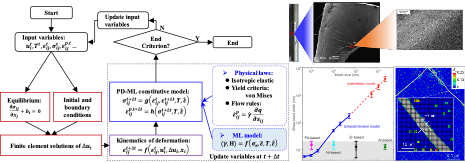
The constitutive relations of engineering materials form the theoretical foundation for describing the intrinsic links between microstructural evolution, service environments, and macroscopic mechanical responses under prescribed loading paths. They play a decisive role in structural design optimization, safety assessment, and service life prediction. With the continuous advancement of high-end equipment in aerospace, energy, and protective applications toward extreme environments, long service life, and high reliability, materials subjected to ultra-high/ultra-low temperatures, long-term creep, high strain-rate impact, and complex loading spectra commonly exhibit pronounced nonlinearity, strong path dependence, and coupled multi-scale spatiotemporal behaviors. These features pose fundamental challenges to conventional constitutive models that rely on empirical assumptions and calibration under limited loading conditions, particularly in terms of predictive accuracy and generalization.
This research direction addresses the constitutive modeling of solid materials under complex and extreme service conditions, with a focus on extending and intelligently formulating constitutive theories within the framework of continuum mechanics. The research spans a wide range of time scales, from ultra-slow creep to high strain-rate impact, involving representative material systems such as polymers, engineering alloys, and protective structural materials; a broad temperature domain from cryogenic to elevated temperatures, with particular emphasis on key aerospace materials such as high-temperature alloys; as well as multi-physics coupling conditions relevant to energy materials. Through microscale simulations and multi-dimensional experimental characterization, generalized constitutive descriptions are developed to consistently capture nonlinear, time-dependent, and path-dependent material behaviors. Building upon these foundations, artificial intelligence and statistical inference techniques are introduced to integrate heterogeneous data sources into a unified modeling framework. The ultimate goal is to establish physics-informed, data-driven constitutive modeling approaches that enable reliable prediction and efficient deployment of material behavior models in complex engineering simulations.
3. Theoretical Solution of Two-Dimensional Elastic Fracture Mechanics
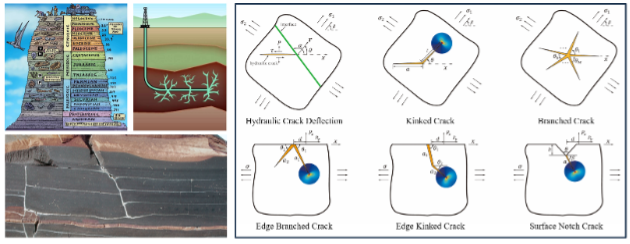
Crack kinking and bifurcation are fundamental phenomena in fracture mechanics, with significant implications for structural integrity and energy extraction technologies. Accurately predicting the path of kinked or branched cracks is crucial for assessing the safety and lifespan of engineering components, as well as for optimizing processes like hydraulic fracturing in shale oil and gas recovery, where creating complex fracture networks is essential. However, the inherent geometric complexity of these cracks has long posed a significant challenge, as traditional methods struggle to precisely calculate key parameters, including Stress Intensity Factors (SIFs), for cracks with arbitrary branch lengths and angles, thereby limiting predictive accuracy and engineering applications.
In addressing this challenge, significant theoretical breakthroughs have been achieved, with profound engineering implications. The research team successfully derived the critical condition governing fracture kinking along weak interfaces (e.g., shale bedding planes) and developed semi-analytical solutions for stress fields and stress intensity factors of branched and kinked cracks with arbitrary length ratios. This methodology establishes a universal framework, enabling predictive modeling of crack path selection based on criteria such as the maximum energy release rate. Looking forward, the research team will focus on several key areas: the role of T-stress in crack behavior, quantitative analysis of shielding/enhancement effects in multi-crack systems, general semi-analytical methods for cracks in finite domains with complex boundaries,elastic-plastic fracture in engineering materials, validation and extension of fracture theories for major engineering applications, and applications of fracture mechanics to engineering challenges such as fatigue crack growth.
4. Reliability, Life Prediction and Mechanics of Lithium-ion Batteries
There is a widespread and urgent demand for a new generation of lithium-ion batteries with multiple excellent properties, such as high specific energy, ultra-fast charging, ultra-long cycle-life, and high security, in the fields of eletrical vehicles, grid energy storage, and aerospace, etc. To achieve these goals, battery systems are increasingly adopting high-expansion materials and solid-state electrolytes, which highlight critical challenges related to mechanical failure and multiphysics coupling mechanisms. Current research, however, predominantly focuses on chemical and material synthesis aspects, often underestimating the essential role of mechanical behavior in batteries. This limited understanding of mechanical principles and multiphysics interactions has hindered the progress of next-generation high-performance batteries, posing significant bottlenecks in their design, manufacturing, safety management, and lifetime assessment.
In response to the above-mentioned challenges, the group has successfully addressed some key demands: a series of consititutive models for electrode materials and advanced structural optimization methods were developed; multiphysics coupling simulation framework was established, spanning mechnical, thermal, and electrochemical fields across particle, electrode, and cell levels; a set of cycle-life assessment criterion based mechanical fatigue principles was proposed; and real-time performance prediction was achieved emloying machine learning enhanced methods. Moving forward, the future research will focus on: deeping the understanding on multiphysics-coupled aging mechanisms in lithium-ion batteries; designing large-format battery structures with high capacity and improved structural and thermal stability; investigating dendrite growth, electrolyte fracture, and interfacial failure mechanisms in solid-state batteries; and developing more accurate state assessment and cycle-life prediction methods grounded in mechanical principles and machine learning techniques.

